The short answer: buy the Timemore Black Mirror Basic 2.0 ($55). It reads to 0.1 g, starts its own timer, shows flow rate, and costs less than two bags of good beans — it is the scale we already recommend in our home espresso setup guide, and a full guide’s worth of comparison did not change that. If your machine’s drip tray is tight, the Timemore Black Mirror Nano ($99) is thinner and tougher. And the Acaia Lunar ($250) is the buy-once café standard — worth it for daily pullers, honest overkill for everyone else. Prices on this page come from our price tracker, and each price is dated where it appears.
Why a scale at all?
Because espresso is a ratio, and you cannot repeat what you cannot measure. The standard beginner recipe — 18 g of ground coffee in, about 36 g of espresso out, in 25–30 seconds — has three numbers in it, and two of them come from a scale. Without one, every shot is a guess and every adjustment is superstition; with one, a great shot becomes a recipe you can brew again tomorrow. Our dialing-in guide is built entirely on those three numbers. A scale is the cheapest upgrade in espresso — cheaper than any grinder, machine, or distribution tool — and it is the one that makes all the others provable.
Contents
What an espresso scale actually has to do
Four things separate an espresso scale from a kitchen scale, and a beginner only needs two of them on day one:
- 0.1 g resolution. Doses live and die in tenths of a gram. Most kitchen scales read in 1 g steps — on an 18 g dose, a 1 g rounding error is a 5% recipe change you never made.
- A built-in timer. Yield without time is half a recipe; the timer should start when the shot does.
- Fast response. To stop a shot at 36 g, the display has to keep up with the pour. A lagging scale means stopping at “36” and landing at 41.
- A thin, water-tolerant body. On the drip tray, the scale’s thickness adds to your cup’s height under the portafilter — and the tray is the wettest square foot in your kitchen.
Here is the split most guides never explain: weighing your dose — beans and grounds, on the counter — needs only the first two. Any honest 0.1 g scale does it. Weighing your yield — the shot itself, live, on the tray — needs all four. That is why a $15 scale can feel perfectly fine for a month and then frustrate you the day you start weighing shots: it was never failing; it was answering an easier question.
The picks at a glance
| Scale | Resolution | Body | Capacity | Price (checked Nov 7, 2026) |
|---|---|---|---|---|
| Timemore Black Mirror Basic 2.0 | 0.1 g | ~26 mm thick | 2 kg | $55 at Amazon |
| Timemore Black Mirror Nano | 0.1 g | 100 × 115 × 20 mm | 2 kg | $99 at Timemore |
| Acaia Lunar | 0.1 g (0.01 g mode) | 105 × 105 × 15 mm, waterproof aluminum | 2 kg | $250 at Acaia |
At a glance
Best for most beginners
Timemore Black Mirror Basic 2.0
Almost every beginner
0.1 g to 2 kg · auto-start timer · real-time flow-rate readout · USB-C · about 26 mm thick
When this guide was published (Nov 7, 2026): $55.00.
Check price on Amazon
Best for tight drip trays
Compact machines, low clearance, small trays
100 × 115 × 20 mm · 0.1 g / 2 kg · CNC aluminum · inclined display · side buttons
Same price as when this guide was published (Nov 7, 2026).
Check price on Timemore
The buy-once premium
Daily pullers buying once, for years
105 × 105 × 15 mm · 0.1 g (0.01 g mode) · water-resistant aluminum · flow-rate indicator · 30-plus-hour battery
Same price as when this guide was published (Nov 7, 2026).
Check price on Acaia
Prices are live from our price tracker and checked against the retailer’s listing; a rating appears only when it was verified the same day. Prices move — the button shows today’s number.
Timemore Black Mirror Basic 2.0 — best for most beginners
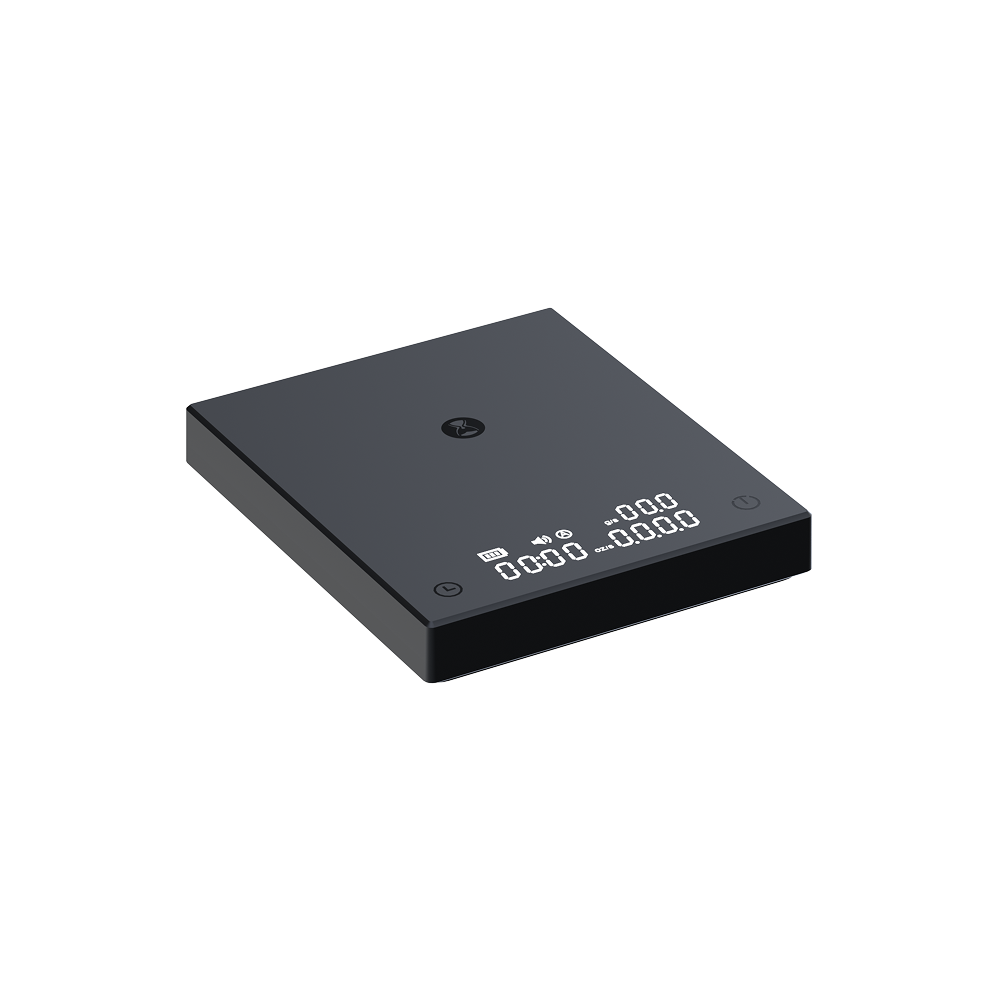
Timemore Black Mirror Basic 2.0
The scale most home bars should start with — and most never need to leave.
Key details
- 0.1 g resolution up to 2 kg
- Auto-start timer that begins when the first drops land
- Real-time flow-rate readout
- USB-C charging
- Big enough to weigh a portafilter directly
- Matte, splash-resistant top
- About 26 mm thick
What we like
- Covers the whole beginner checklist in one slab — 0.1 g, auto-timer and flow rate
- Big enough to weigh a portafilter directly, so dose-weighing is a one-step habit
- Matte top shrugs off splashes
Watch out for
- The thickest scale here at about 26 mm — on a machine with low spout clearance, pair it with a short espresso cup rather than a tall latte glass
- The charging port is not sealed — wipe it down rather than rinsing it, and don’t let it live in a puddle on the tray
When this guide was published (Nov 7, 2026): $55.00.
The Basic 2.0 covers the whole beginner checklist in one $55 slab: 0.1 g resolution up to 2 kg, an auto-start timer that begins when the first drops land, a real-time flow-rate readout for spotting a shot that runs fast, and USB-C charging. It is big enough to weigh a portafilter directly, which makes dose-weighing a one-step habit, and its matte top shrugs off splashes.
Know its two limits. At about 26 mm it is the thickest scale here — on a machine with low spout clearance, pair it with a short espresso cup rather than a tall latte glass. And while the top surface is splash-resistant, the charging port is not sealed: wipe it down rather than rinsing it, and don’t let it live in a puddle on the tray. Within those lines, it is the scale most home bars should start with — and most never need to leave.
Who it’s for: almost every beginner. Who should NOT buy it: owners of very low-clearance machines who brew into tall cups — look at the Nano.
Timemore Black Mirror Nano — best for tight drip trays

Timemore Black Mirror Nano
The espresso specialist of the Timemore family — a wedge that fits trays the Basic 2.0 crowds.
Key details
- 100 × 115 × 20 mm body
- 0.1 g resolution / 2 kg capacity
- CNC-machined aluminum body
- The most responsive scale Timemore sells
- Inclined display, readable mid-shot
- Buttons on the side, away from spray
- Flow-rate readout sharing the display with the timer
What we like
- Fits trays the Basic 2.0 crowds
- Inclined display is readable mid-shot without crouching
- Side buttons — a channeling spray hits nothing here
- CNC-machined aluminum body
Watch out for
- The small platform means dose-weighing happens in a cup or dosing vessel rather than a bare portafilter
- The flow-rate display shares space with the timer instead of getting its own screen
- It costs nearly double the Basic 2.0 for the same 0.1 g / 2 kg numbers — you are paying for fit and response
Same price as when this guide was published (Nov 7, 2026).
The Nano is the espresso specialist of the Timemore family: a 100 × 115 × 20 mm wedge that fits trays the Basic 2.0 crowds, with a CNC-machined aluminum body that makes it the most responsive scale Timemore sells. Two design choices are quietly brilliant for espresso: the display is inclined toward you, readable mid-shot without crouching, and the buttons sit on the side — so a channeling spray that would tap a top-panel button into chaos hits nothing here.
The compromises are size and price. The small platform means dose-weighing happens in a cup or dosing vessel rather than a bare portafilter, the flow-rate display shares space with the timer instead of getting its own screen, and at $99 it costs nearly double the Basic 2.0 for the same 0.1 g / 2 kg numbers. You are paying for fit and response — on the right machine, that is exactly the right trade.
Who it’s for: compact machines, low clearance, small trays. Who should NOT buy it: anyone whose tray already fits the Basic 2.0 — save the $44.
Acaia Lunar — the buy-once premium

Acaia Lunar
The scale on café bars worldwide — a body built to be forgotten.
Key details
- 105 × 105 × 15 mm — the thinnest scale here
- 0.1 g resolution, with an optional 0.01 g high-readability mode
- Water-resistant anodized aluminum shell
- Two-year warranty that explicitly covers water damage
- Response is effectively instant
- Flow-rate indicator
- Battery runs 30-plus hours between USB-C charges
What we like
- The thinnest scale here, at 15 mm
- Water-resistant shell with a two-year warranty that covers water damage
- Effectively instant response, and the reference flow-rate indicator
- 30-plus hours of battery between charges
Watch out for
- You are paying for durability, thinness and speed — not for more accurate espresso: a Basic 2.0 makes the same 36 g stop
- Honest overkill for beginners still deciding whether espresso is their hobby
Same price as when this guide was published (Nov 7, 2026).
The Lunar is the scale on café bars worldwide, and at home it plays a different role than the two Timemores: not better numbers — its 0.1 g resolution (with an optional 0.01 g high-readability mode) matches scales a fifth of its price — but a body built to be forgotten. At 105 × 105 × 15 mm it is the thinnest here; the anodized aluminum shell is water-resistant enough that Acaia’s two-year warranty explicitly covers water damage, a claim almost no electronics maker will underwrite. Response is effectively instant, the flow-rate indicator is the reference implementation, and the battery runs 30-plus hours between USB-C charges.
The honest beginner math: you are paying $250 for durability, thinness, and speed — not for more accurate espresso. A Basic 2.0 makes the same 36 g stop. Buy the Lunar if you pull shots daily, expect to for years, and want the scale to simply never be a thought again. Everyone else is funding a café habit they don’t have.
Who it’s for: daily pullers buying once, for years. Who should NOT buy it: beginners still deciding whether espresso is their hobby — the Basic 2.0 and four bags of beans is the smarter $250.
What about a $15 scale?
A fair question, and the answer is genuinely “it depends what you weigh.” The current crop of ~$15 coffee scales (the KitchenTour class) really do read 0.1 g and include timers — for weighing your dose on the counter, they are honest tools, and starting there beats not starting. Where they fall down is the tray: response slow enough that the display trails the pour, bodies too thick for tight clearance, and no water protection in the wettest spot in the kitchen. The usual upgrade story — $15 scale in month one, a Basic 2.0 in month four — costs more than starting at $55. But if $15 is what gets a scale onto your counter today, take it, weigh your dose religiously, and upgrade when you start weighing yield.
How you’ll actually use it: dose, yield, time
Three numbers, every shot. Weigh the dose in the portafilter (18 g). Tare the cup on the scale under the portafilter, start the shot and the timer together, and stop the pump a gram or two early — the last drips land you on 36 g. Note the time: 25–30 seconds is the beginner window. Sour and fast? Grind finer. Bitter and slow? Coarser. That one loop, repeated, is the entire skill of espresso — the scale is what makes the loop visible. (The full method, with troubleshooting, lives in our dialing-in guide.)
How we chose: Espresso Journey does not own these scales, so this guide is built from manufacturer specifications, prices verified on November 7, 2026, and published owner and reviewer reports — no hands-on testing claims. One source note: the Nano’s Amazon listing would not load for verification today, so its price and link go to Timemore’s own store.
Shopping today? Our price tracker checks the products in this guide twice a day against the retailers’ own listings. See which ones are actually on sale right now on our espresso deals page — every price verified, and a deal whose price climbs back up comes straight down.
Frequently asked questions
Do I really need a scale for espresso?
Yes — it is the one accessory that is not optional if you want repeatable shots. Espresso is brewed to a ratio (start with 18 g in, 36 g out); without a scale you cannot hit the ratio, and without hitting it you cannot tell whether a change to grind, dose, or time helped. Every other accessory on your counter is a refinement; the scale is the measurement the refinements stand on.
Is 0.1 g resolution necessary, or will a 1 g kitchen scale do?
0.1 g is necessary. A 1 g kitchen scale rounds an 18 g dose by up to a gram — about a 5% swing — and cannot show a shot approaching 36 g with any precision. Any scale in this guide reads 0.1 g; that single specification is the line between a kitchen scale and an espresso scale.
Which of these scales fits under a Breville Bambino?
All three can work; the fit is about total height — scale plus cup — under the portafilter. The Lunar (15 mm) fits with anything. The Nano (20 mm) fits with most cups. The Basic 2.0 (about 26 mm) fits with a standard espresso cup but can crowd out tall latte glasses; if you mostly make milk drinks in tall glasses on a compact machine, the Nano is the safer buy.
Is the Acaia Lunar worth it for a beginner?
For most beginners, no — not because it isn’t the best scale here (it is), but because its advantages are durability, thinness and speed, not accuracy: it weighs the same 0.1 g as the $55 Timemore. Buy it when you are pulling shots daily and certain the hobby is permanent. Until then, the Basic 2.0 plus the $195 you saved, spent on fresh beans, will improve your espresso more.
What is flow rate, and do I need it?
Flow rate is how fast espresso is landing in the cup, in grams per second, shown live. It helps you see a shot speeding up (often a channel forming) before the total weight tells you. Useful, not essential: dose, yield and time will carry a beginner for the first year. Both Timemores and the Lunar show it; treat it as a bonus, never the reason to buy.